- Next TMT
- Posts
- NAB 2026 Spotlight: Broadcasting's signature trade event gets overtaken by AI-based streaming tech
NAB 2026 Spotlight: Broadcasting's signature trade event gets overtaken by AI-based streaming tech
In a special show preview issue of our Thursday newsletter covering all things technology, media and telecom, Hollywood decides to fight David Ellison's big WBD purchase ... about six months too late; and NBCU controlled more than 13% of all TV viewing in February


Daniel Frankel & David Bloom
April 16, 2026
Presented by

Next TMT Talks Partner Discussion
Gen Z consumers tend to take their sports via 16×9 highlights on social. We talked to Grabyo’s Gareth Capon about what’s needed to tap into this massive audience.
Vertical short-form production tech proliferates alongside format’s fervent young fans, but the media business model has some (harsh) critics
Vertical video, the 9x16 mobile-friendly format, is having a moment. Netflix, Disney and Fox have embraced the format, as have major brands and creators. The Hollywood guilds have rolled out special contract provisions, and new companies are announcing ventures seemingly weekly (even more this week, days before NAB).
One of the cool new uses is for creating not just clips but entire streams of sports, news and other live events. Decade-old clips specialist Grabyo (see my interview with CEO Gareth Capon above) partnered with Amazon’s AWS to stir together streaming’s latest buzzwords (vertical, live, mobile, sports, social media, engagement) into a compelling cloud-based service that can convert an entire event or contest, in near-real time, into a mobile-ready full-length program.
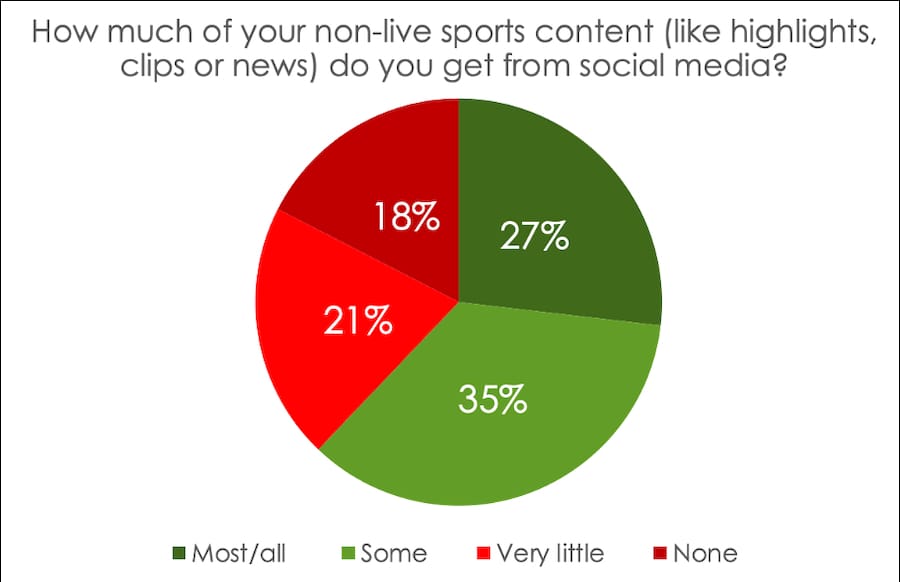
Courtesy of Hub Entertainment Research’s 2025 ‘What’s the Score: The Evolution of Sports Fans and Sports Media’ survey of more than 3,800 adult consumers.
It’s a hit with audiences, too, Capon said. Grabyo (exhibiting at W2115 West Hall in the Las Vegas Convention Center) recently telecast a semi-pro skateboarding event out of Phoenix, generating a live vertical stream of the entire event on TikTok. The result: “three times the usual viewing that the normal stream on YouTube did,” Capon said.
@the_platfrm We’re headed to Desert West Skatepark for Cowtown’s 24th Annual PHXAM! Get ready for a weekend of skateboarding chaos where the best AMs w... See more
A couple of lessons: There’s an untapped audience on social, and it might be bigger than you think. “What is clear is that this is where a lot of the audience are all the time, and they're not necessarily sitting at the TV,” Capon said.
Several other companies at NAB will be showing off clipping tools, including ScorePlay, which with Grabyo will be part of an AWS-sponsored conference panel. OpusClip and Replo will be part of a separate session on “The Age of Clipping is Here.” More generally, NAB is spotlighting clipping as one of the year’s big themes, alongside AI and the creator economy. (Counterintuitively, NAB will feature a Sunday-afternoon appearance from one of short-form video’s biggest stars, Mark Fischbach, aka YouTuber Markplier, who will talk about his big transition … to long-form filmmaking.)
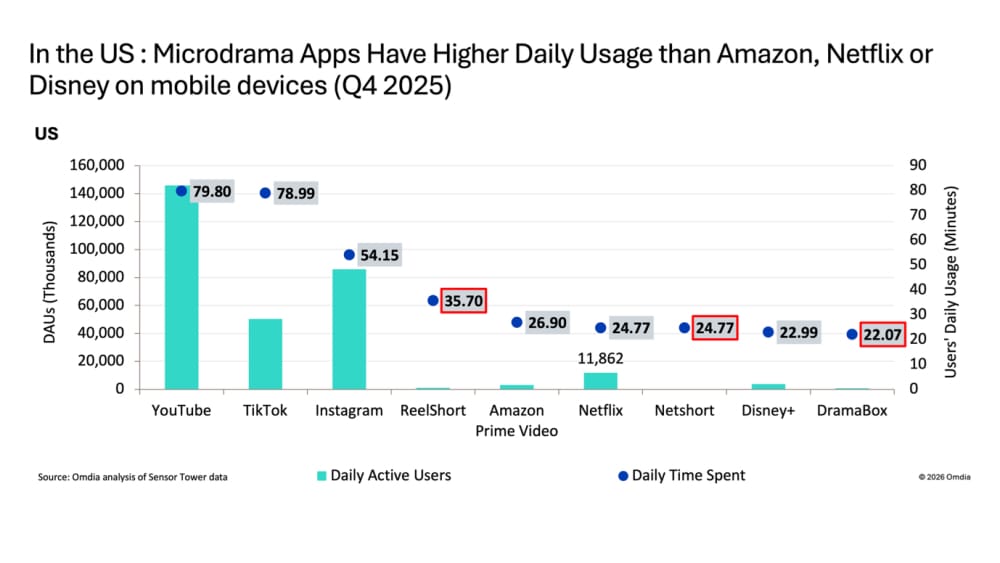
Outside the conference, producer Tommy Harper (Beetlejuice, Beetlejuice; Wednesday) launched VeYou, featuring “premium vertical, short-form serialized dramas” in a variety of scripted genres, beginning with action-romance Love Under Fire. Harper promises somewhat higher budgets, enhanced with AI-powered visual effects. The new company also has a distribution partnership with Google TV and Google Play.
Not everyone loves other parts of vertical video — specifically, the business model.
At StreamTV Europe in Lisbon earlier this week, media biz consultant Evan Shapiro reiterated his pungent February declaration that the vertical dramas model is “total bullshit.”
The model uses the same whale-hunting, free-to-play mobile game economy that first surfaced in China. As Shapiro notes, the resulting product is generally poor, the talent treated like cattle. Worse, the economic model, which relies on cliffhangers at the end of every 90-second episode, doesn’t make sense, losing money thanks to a reliance on expensive customer-acquisition campaigns.
Shapiro urges a different approach, using ad-supported models instead of extortionate micropayments and ruinously expensive customer acquisition. Subscription-based models, more common in the West, may work too, at least at scale. Will a shift to Shapiro’s suggested model work out? Stay tuned. That’s just another (big) vertical video cliffhanger.
— David Bloom
Grabyo: Live Cloud Production, Clipping and Distribution


Live sports streaming glitches translate to riches for the right solution providers
At the top of the lobbying agenda at NAB headquarters in Washington is, “How can we convince the big sports leagues and their TV rights holders to stay in the broadcast ecosystem?”
In the specific case of the NFL, which watched helplessly last week as Murdoch Family angling generated bipartisan Congressional letter-writing, and ultimately an actual DOJ investigation on whether the league should still keep its broadcast-era antitrust exemption in the streaming age, it’s more a matter of, “How can we make them stay?”
However, in the exhibit halls of the Las Vegas Convention Center starting this weekend (NAB 2026 officially runs April 18-22), attendees to the National Association of Broadcasters signature trade show likely will get a distinct feeling that live sports has already checked into a motel with free Netflix. (AKA, broadcast’s “The Heartbreak Hotel,” which in addition to long-endured TV usage share declines, saw NAB Vegas attendance drop around 10% last year to about 55,000.)
As a marketing focus, nothing can or will trump the hype around AI. But streaming solutions providers are all-in on live sports, according to Sig Luft, co-founder and CEO of Vancouver-based edge-CDN company Netskrt, because “sports creates a lot of new problems” to solve.
Focused on the internet’s “Level 7” — the so-called “edge” region, on which consumer-facing applications run directly — Netskrt will once again appear in consultant Dan Rayburn’s Streaming Summit, messaging prospective clients about its specialty CDN (content delivery network) technology, designed to cover a streaming company’s six when live sports suddenly spikes network demand to 11.
If you watched (or tried to!) the final, intensely dramatic minute of Tuesday’s NBA Eastern Conference play-in game between the Miami Heat and Charlotte Hornets on Amazon Prime Video — specifically, that pivotal 22-second span that glitched for viewers — you know exactly the kind of problem that Luft and his team will actively propose solving in West Hall 201. (Amazon says it’s investigating said glitch.)
In fact, sports (mainly the streaming kind) is such a big part of NAB’s curriculum, the conference will feature its second annual “Sports Summit.” There, Luft and Netskrt will be joined by speakers from big-name tech firms including Nvidia, AWS, Google and Dolby, as well as FIFA and the NFL.
— Daniel Frankel
Streaming live sports is hard. With over 500 events in the last year, we know


Say ‘workflow automation’ again! We double dog dare you …
Just perusing NAB conference sessions and countless pre-show PR pitches, it’s clear “workflow” will be a significant theme, especially how professional video providers and marketers integrate AI into their existing and complicated systems in useful ways.
BIScience, which provides ad intelligence for 2,000 big brands, is embedding a full AI layer into its platform so users can use plain English to quickly create sophisticated database queries, and receive structured responses with charts in seconds.
Cinelytic, which advises studios on films from greenlight decisions to theatrical marketing, is adding an AI-driven predictive model to forecast in seconds the likely box office and ancillary revenues for a given project across 80 territories.
Veritone announced Discovery Content Intelligence, to help teams better understand and use their libraries of video and audio. The new tools can quickly pull up specific moments, analyze large amounts of programming, track brand mentions, and verify when and where content aired.
Modulate, meanwhile, is offering Ensemble Listening Model, a stack of smaller, more specialized and efficient AI models for tasks such as transcription and moderation, obviating the need for expensive and resource-hogging general systems. Modulate systems monitor the sometimes-problematic online conversations in major videogames such as Call Of Duty to protect players from abuse and harassment.
Akta is demonstrating its own AI-fueled vertical-video conversion tools, search, captioning and translations, and scheduling, along with cloud-based master control, ad optimization, and automated distribution. The company calls it the “AI-first operating layer for the future of video.”
And the arch rivals in video production are all debuting big improvements to customers’ workflows. Avid is integrating Alphabet’s Google Cloud directly into its Core SAAS system, giving teams immediate worldwide access to footage, AI-fueled search, agentic logging of footage, even the capability to generate B-roll matching original footage.
Adobe’s adding much-requested Kling 3.0 and Kling Omni 3.0 to the 30 video-generating AI models already available through its Firefly browser-based video editor. Adobe also overhauled Premiere Pro’s video color-grading system, wrapping a three-year upgrade process for a complex and crucial finishing step in pro video production.
And Blackmagic is adding superfast 100G Ethernet connectivity to flagship URSA Cine cameras that capture either 12K-resolution video or Apple Vision Pro-ready immersive video (which generates double windows at 8K resolution), easing the considerable challenge of moving gigantic video files from camera to production systems. Blackmagic’s DaVinci Resolve do-everything app gets more AI tools, Fairlight live audio mixing, and, in a flip of Adobe’s announcement, brings its popular video color-grading tools to still images.
The bigger picture here, of course, is that AI is moving into a next stage, as companies come to acceptance of AI’s continued meaningful presence, and figure out how to supercharge the processes they’ve built up over years or even decades without having to tear down everything they know to switch to promising but unproven new technologies.
— D.B.
Unify Your Video Workflow with Akta AI
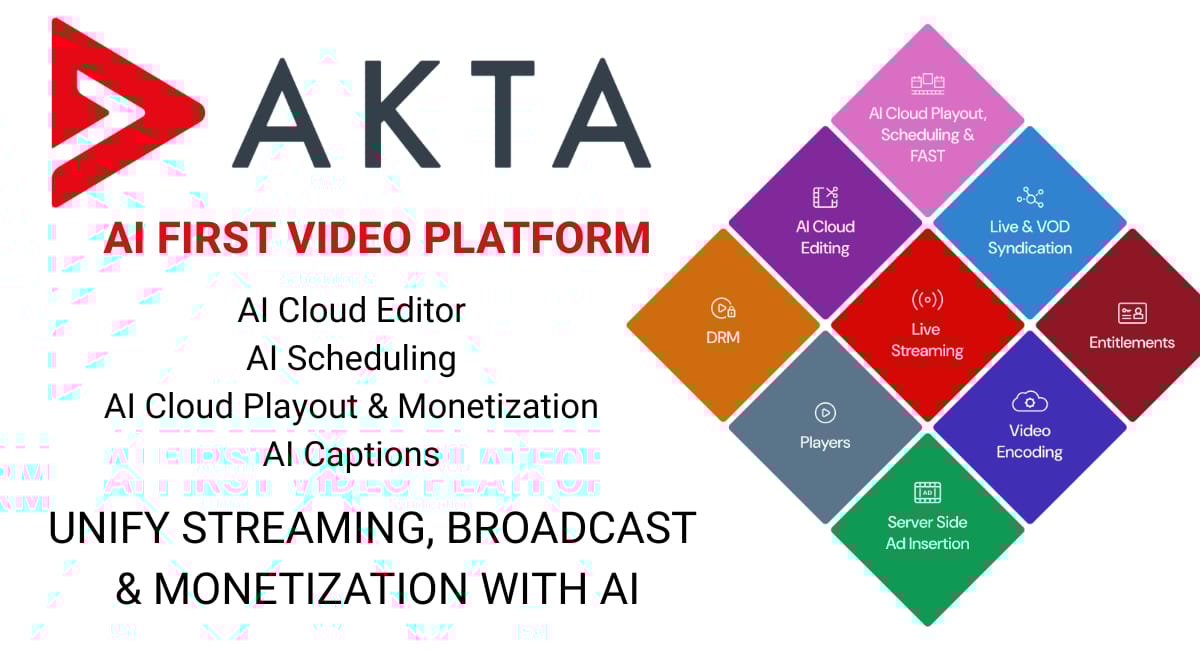
Visit AKTA to see how AI transforms video streaming, FAST scheduling, playout & monetization.
The Five Spot
A few other things you should know…
Hollywood sticks it to the $110 billion Paramount/Warner merger … about six months too late
If David Ellison thought he could exhale after wresting Warner Bros. Discovery from Netflix, he thought wrong.
This week, 1,000 Hollywood notables signed a petition opposing Paramount Skydance’s $110 billion WBD takeover. So did Michael O’Leary, head of theater owners trade group Cinema United, calling the resulting market concentration bad for his members, moviegoers and Main Street too.
All of this is probably at least six months too late, but may register with antitrust regulators, at least outside the pliant matadors at the U.S. Department of Justice and Federal Trade Commission.
Regardless, Ellison — who will next week host an (unseemly?) dinner for the man who enabled his (monopolistic) ambitions, President Donald Trump — is charging ahead. He told Upfronts event attendees Wednesday that Cindy Holland, the former Netflix exec now heading PSKY’s direct-to-consumer business, has greenlit 20 new or returning shows for Paramount+ and Pluto, featuring the inevitable Nicole Kidman and Anne Hathaway, among other big stars.
One bit of sort-of good news for Ellison ahead of the May 21 demise of Stephen Colbert’s Late Show: the first man to hold that job, David Letterman, averred on the Barbara Gaines Show (see above) that CBS executives “don’t want to spend any money, so they’re going to make money.”
Byron Allen will pay CBS for access to the late-night window, syndicate his on-and-off-again comedy talk show Comics Unleashed, and sell ads. That’s a business Allen will likely do well in. Colbert says after his show ends, he plans to go write a screenplay based on The Lord of the Rings.
— D.B.
Nielsen’s February Gauge finally debuts … They’re not booing, they’re chanting ‘YouuuuTuuuube’
Nielsen retreated into a bunker the last several months as its linear and streaming TV clients chose to take their more-heated-than-ever rivalry out on the thin ice of the research company’s methodology.
This week, a month late, Nielsen finally published its widely popular (but also controversial!) February ranker, The Gauge, measuring market share of U.S. TV viewing. After its streaming clients kicked up a fuss about changes to the way it measures viewership, Nielsen went back to the old ways, punting the revision to the fall.
The results were predictable: All of streaming (save for that totally not-that-negligible amount done via mobile devices and/or through virtual MVPDs) tacked on another 4.5 percentage points YoY in market share (it’s now at 48%). Meanwhile, NBCUniversal and its Versant spinoff — super-charged by the Super Bowl and the Winter Olympics — dominated viewership share.
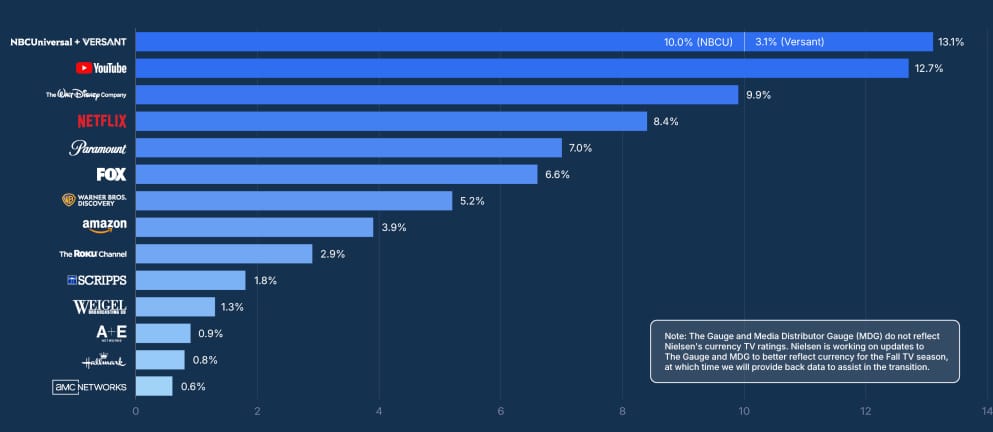
But the flack fired at Nielsen keeps on coming.
“Nielsen’s announcements to delay their February Gauge report (with its anticipated spike in TV audience totals), and also revert Gauge’s math to a method now proven to undercount all TV forms throughout the upfront season, are both indefensible manipulations that run completely counter to the role of a fair and neutral measurement and currency data provider, “ said Sean Cunningham, CEO of trade group the Video Advertising Bureau.
— D.F.
Sure, it’s an ‘oligarch thing,’ but we can all understand that with his $11.57 billion Globalstar purchase, Jeff Bezos’ satellite internet gambit just pulled closer to Elon Musk and Starlink
When you’re market-capped at $2.7 trillion, you can just start launching satellites and calling yourself a telecom. … And they let you do it.
Already encouraged by the FCC to fill low Earth orbit (LEO) with satellites, Amazon earlier this week paid a mere rounding error ($11.57 billion) for a company, Globalstar, that provides its (fledgling?) cellular buildout with a direct-to-devices service portfolio.
The purchase helps Jeff Bezos’ Amazon Leo significantly in its effort to catch up to Elon Musk’s Starlink, which already has 10 million subscribers globally using cellular devices connecting to the internet via satellites and not a terrestrial towers.
Simultaneously, Amazon said that it has partnered with Apple to have Leo power satellite services for iPhone and Apple Watch.
— D.F.
Last week, Jason Zoloft, senior consultant for Hub Entertainment Research, visited Next TMT’s virtual studio to talk about his firm’s latest “Evolution of Video Branding” survey. Published in late March, the data showed marked decreases in consumer awareness in regard to what network of origin current popular shows belong to.
We surmised in our Monday issue news lead that an increasing number of viewers are discovering and initiating playback of premium originals through aggregation platforms like Amazon Prime Video Subscriptions and Roku Channel. They often have no idea where the show actually came from. As our producer, Vivian, might say, we were right!
As we were still sifting through the two-week-old data Monday morning, Hub released a new report, its 2026 ‘“Connected Home” survey of 2,659 consumers, in which 54% of respondents say they pay for and watch at least one subscription streaming service through Amazon. That was up 4 percentage points in one year.
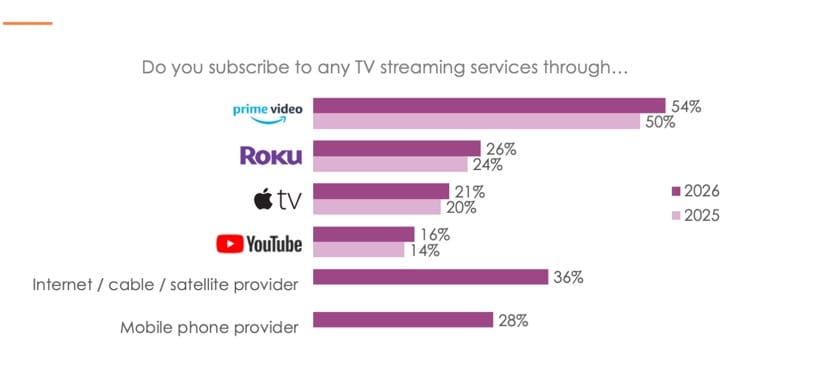
Courtesy of Hub Entertainment Research.
Hub also provided this current snapshot of what streaming platforms control what share of American living rooms. There’s not much change here: Samsung is widely known to natively control more smart TV’s than anyone else, but Roku still leads all TVOS platforms in market share through its long-held dominance in peripheral streaming gadgets, in addition to integration into its own and OEM-provided smart TVs.
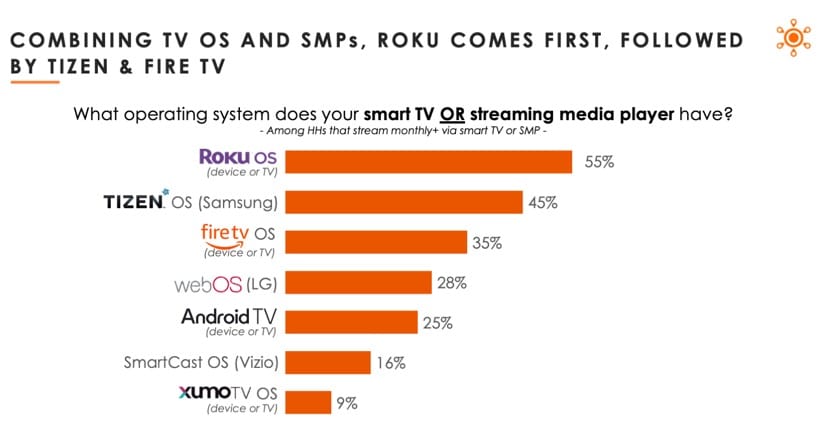
Courtesy of Hub Entertainment Research.
— D.F.
HBO Max shows dominate Looper Insights’ March ‘Streamer of the Month’ ranker
Not surprisingly, Amazon Prime Video and The Roku Channel remained atop Looper Insights’ March ranking of streaming app merchandising visibility.
Notable to our aforementioned point about streaming brand awareness: As measured by Looper’s proprietary Media Placement Value ($MPV) metric, HBO Max shows ranked 1-3 in securing virtual shelf-space value for the March “Streamer of the Month” ranker. But based on $MPV, HBO Max isn’t nearly as visible as Prime Video or Roku.
According to Looper, the visibility streaming companies and their titles get on TVOS homepages and the like is increasingly influenced by aggressive SVOD promotions, including a 90-day, no-cost free trial conducted by AMC+, as operators shift their go-to-market strategies away from relying on exclusive originals and towards price-led competitive zeal.

— D.F.
Reply